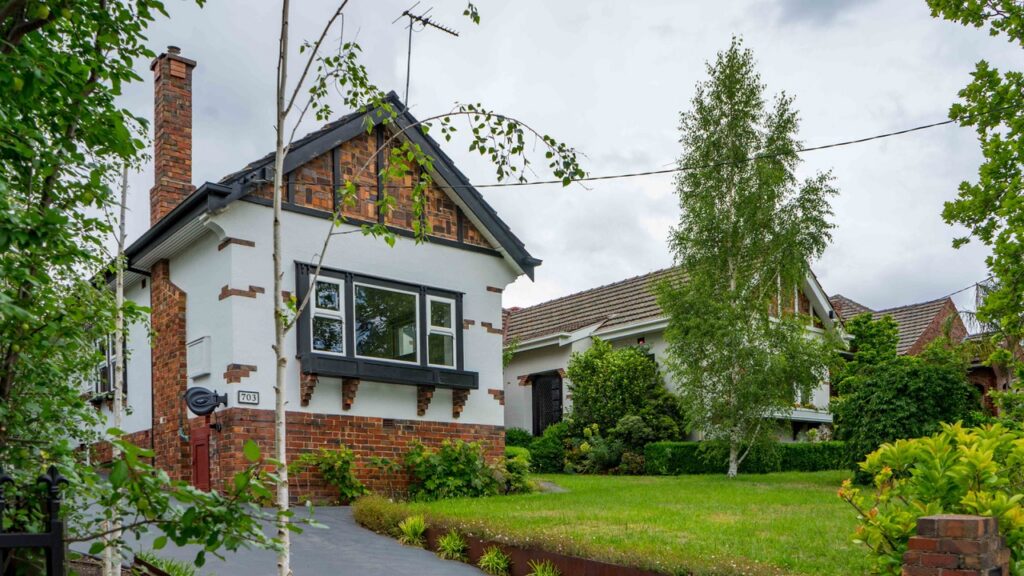
Heritage at risk
This page explains why many councils, heritage organisations and planning experts are concerned that Boroondara’s heritage streetscapes may be gradually transformed under the new planning framework.
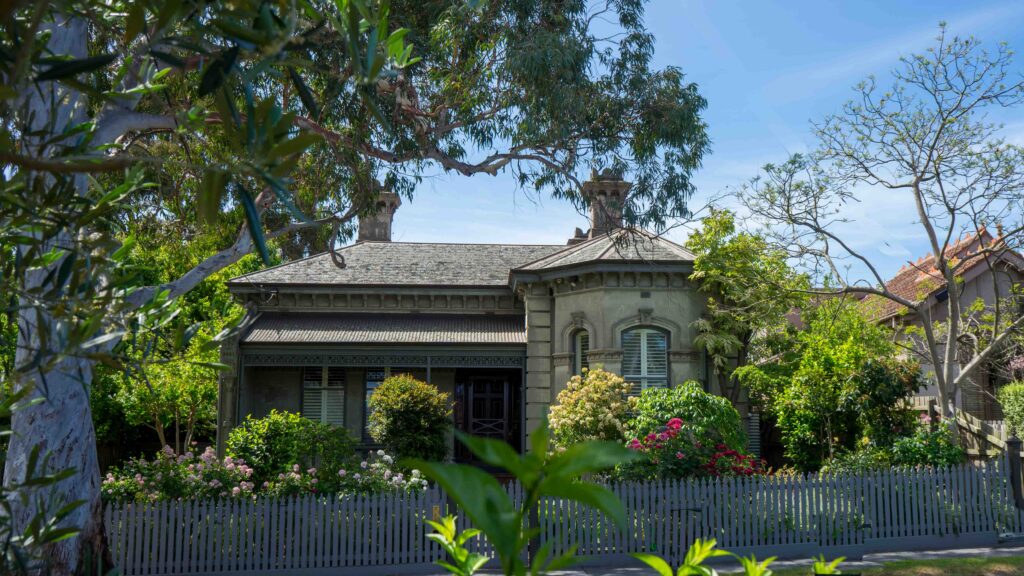

Combined, the first eight activity centres in Boroondara cover more than 40% of the municipality and include approximately 80% of its Victorian, Federation, Edwardian and Inter-war heritage homes.
Heritage homes and precincts are protected because their cultural heritage value has been independently assessed against established heritage criteria. This is typically a rigorous process involving detailed historical and architectural analysis.
The heritage precincts and streetscapes affected within the Kew Junction, Hawthorn, Glenferrie and Auburn catchments can be seen in this map.
xx
“The heritage overlay will remain” – a disingenuous claim
The Victorian Government has sought to reassure Boroondara residents by repeatedly stating that heritage precincts will continue to be protected because the Heritage Overlay will remain in place and heritage precincts have mostly been rezoned for 3–4 storeys not 4–6 storeys. It has stated that planning decisions affecting heritage precincts or individual heritage places will continue to take heritage significance into account.
The Government has also acknowledged that heritage will become one ‘consideration’ to be balanced against the new Housing Choice & Transport Zone’s objectives of increasing housing density and facilitating housing diversity.
Importantly, the Government has declined to provide modelling showing its long-term vision for heritage streetscapes under the new planning framework.


Why the zone matters for heritage
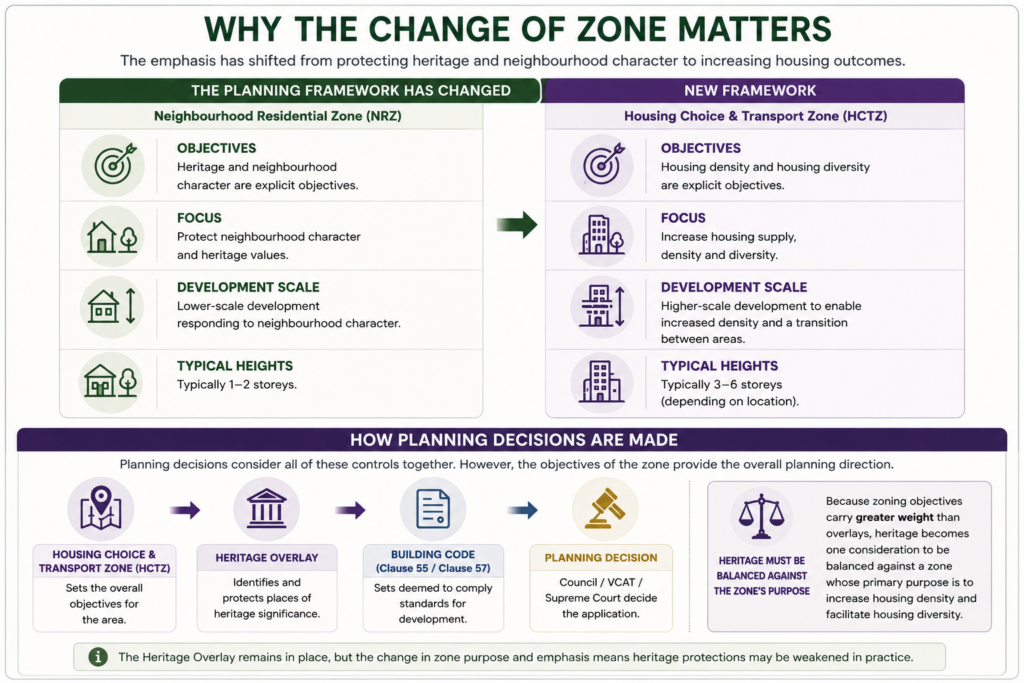
The concern is not that the Heritage Overlay has been removed. The concern is that heritage must now be balanced against a zone whose primary purpose is to increase housing density and diversity.
A key concern raised by Boroondara Council and peak heritage bodies is that the strength of heritage protection does not come only from the Heritage Overlay itself, but also from the underlying zoning of the land.
Many heritage areas in Boroondara now located within the 10-minute walkable catchments were previously zoned Neighbourhood Residential Zones (NRZ), which explicitly prioritised heritage and neighbourhood character and lower-scale development of 1–2 storeys.
The Housing Choice & Transport Zone (HCTZ), by contrast, prioritises housing density and housing diversity and contains no explicit reference to heritage or neighbourhood character. Heritage experts argue that a zone whose purpose is to facilitate increased housing and provide a transition in density cannot provide the same degree of heritage protection as the previous zoning framework.
Because planning schemes give greater weight to zoning objectives than overlays, Boroondara Council, heritage experts and peak heritage bodies are concerned that heritage protections may be weakened in practice, particularly where decisions are ultimately determined by VCAT or the Supreme Court.
xx
x
Pressure to reduce heritage protections
Concerns have also been raised about increasing pressure from parts of the development industry and some housing advocacy groups to reduce heritage protections across Melbourne.
Public commentary has included claims that heritage protections are:
- “Blocking” housing supply.
- Preventing younger Victorians and families from accessing housing.
- Restricting urban density outcomes.
Senior figures within the Department of Planning have also reportedly stated that Melbourne has “too much heritage”, while government modelling and presentations suggest that heritage loss within some precincts is anticipated as part of the expected planning outcomes.
At the same time, planning consultants and industry groups have increasingly advocated for changes to heritage policy in order to facilitate greater urban density. For example, a planner at Ratio, a highly influential urban planning consultancy, outlined the case for substantially reducing the number of heritage precincts across Melbourne (Read Article).
xx
Concerns raised by heritage organisations
A number of major heritage organisations and experts have expressed concern about the impact of the reforms on Melbourne’s heritage precincts.
The National Trust (Victoria) and the Royal Historical Society of Victoria released a joint statement titled “More Housing and Heritage Must Go Hand in Hand” (Read statement). The Heritage Committee of the RHSV also held a public forum titled “Heritage and the New Housing Zones”, which included presentations from heritage and planning experts, including representatives from Boroondara Council (View presentations).
Charter 29 – an eminent group of architects and planners advocating alternative approaches to housing growth – has also raised concerns regarding the impact of the reforms on heritage precincts and neighbourhood character (Read bulletin).

Government modelling and expected change
Concerns have also been raised about government modelling and presentations shared with councils during consultation processes.
Some stakeholders believe the modelling indicates an expectation that substantial change and heritage loss will occur within Activity Centre catchments over time.
Government modelling presented to Boroondara Council reportedly indicated that the degree of expected change within heritage precincts was approximately 50% lower than in non-heritage areas implying that significant change was nevertheless still anticipated within heritage streetscapes.
xx
Findings of the Legislative Council Inquiry 2025
The Legislative Council Inquiry into Victoria Planning Provisions amendments examined extensive evidence from councils, planning experts, heritage organisations, community groups and members of the public. In its final report, tabled in May 2025, the Inquiry acknowledged concerns about the potential impact of the planning changes on Melbourne’s heritage precincts and recommended that stronger heritage protections be considered (Read report).
The Inquiry found that concerns raised by submitters regarding risks to heritage and heritage values were valid and that stronger protections should be considered for Melbourne’s heritage buildings and precincts.
Finding 9: The committee acknowledges that the concern expressed by many submitters that heritage and heritage values are at serious risk of being compromised by these planning amendments are valid. Protections should be available to protect our city and its magnificent heritage buildings and zones.
The Standing Committee on Activity Centres also made recommendations to protect heritage that were ignored by the Minister for Planning.
Finding 12: The advice of the Standing Committee on Activity Centres specifically provided advice to change the planning scheme amendments to protect heritage. This advice was not followed by the Minister for Planning.
xx
Heritage overlays and “deemed-to-comply” pathways in walkable catchments
Under the new planning framework, a multi-dwelling development within a Heritage Overlay needs planning permission on at least two grounds:
- The relevant building code or “deemed-to-comply” standards – Townhouse & Low-Rise code (up to 3 storeys) and the Mid-Rise Code (4–6 storeys).
- Heritage provisions under the planning scheme.
If a development complies with the building code standards, the “deemed-to-comply” provisions substantially limit opportunities for community objections and prevent the community from initiating a review at VCAT.
If a development does not comply with the codes, Council can consider whether the objective of the standard is met and approve or refuse the application on that basis. In this instance, the community’s right to challenge a Council decision at VCAT remains.
Heritage considerations may still provide grounds for refusal or challenge. However, any objections or appeals are effectively limited to heritage matters rather than the broader development as a whole.
This creates concerns that developments meeting the new density and building standards may still proceed within heritage precincts, with heritage protections carrying less practical weight than under the previous planning system.
For more information on planning schemes, zones, overlays and codes, see Resources → Planning Explained. For a broader discussion of heritage and neighbourhood character, see Concerns → Heritage and neighbourhood character and for information on the Government’s planning changes, see Government Plans.