
Townhouse and Low-Rise Code (up to 3 storeys)
The Townhouse and Low-Rise Code is a new Victoria-wide planning control for residential developments of up to 3 storeys. It replaces ResCode and localised planning rules developed by councils over decades and at significant cost to ratepayers.
Like the Mid-Rise Code, it introduces a “deemed-to-comply” pathway: if a proposal meets a set of numerical standards, councils must approve it.
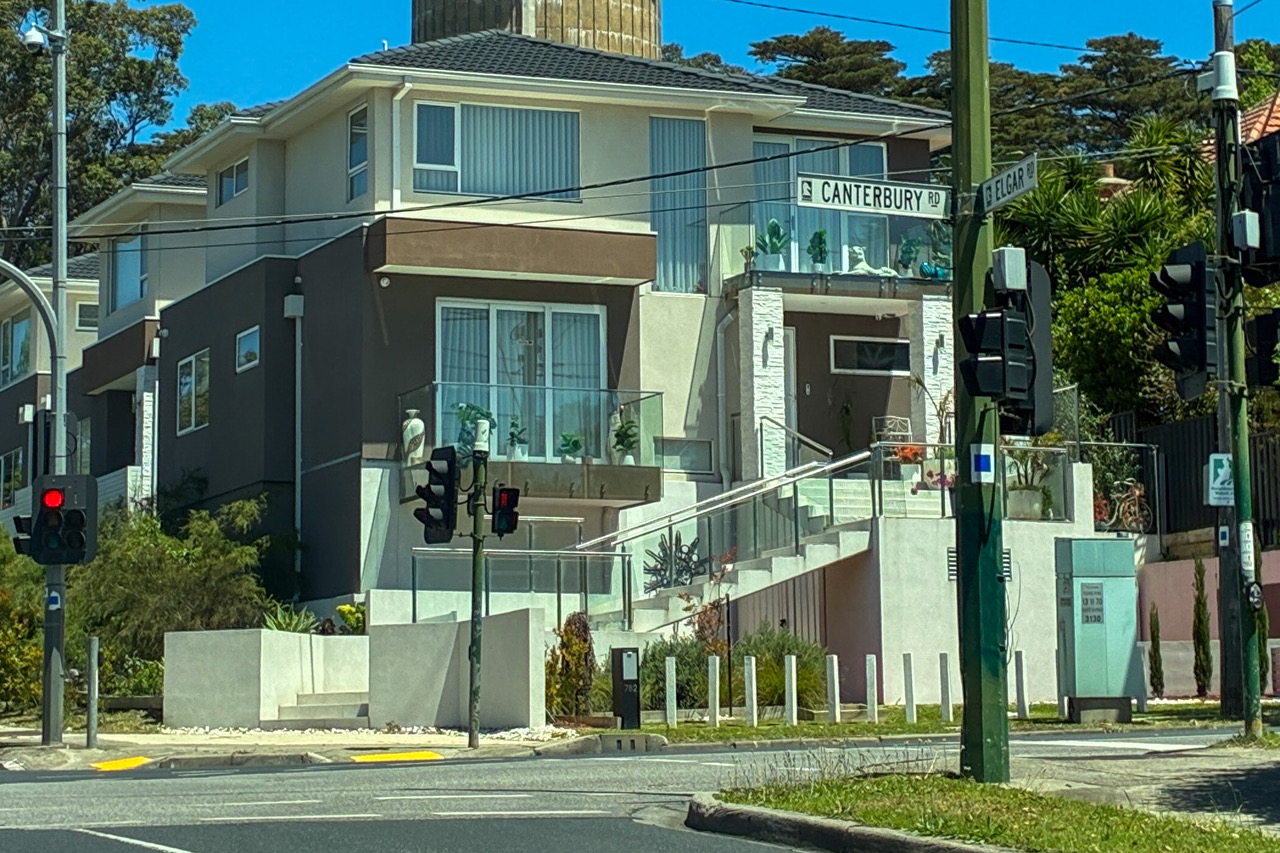
A shift to automatic approvals
This reform fundamentally changes how planning decisions are made.
If a development complies with the code:
- A planning permit must be issued
- Council discretion is effectively removed by preventing consideration of local context
- Community objections carry no weight
- There is no right to appeal the decision at VCAT
A council is not able to consider contamination risks or new flood maps that are not reflected in a flood overlay. Thousands of properties have recently been identified as at flood risk by Melbourne Water. It will take some years for the overlays to be implemented and in the mean time the new maps cannot be considered and the risk managed.
If a proposal does not meet one of the standards, only that specific element can be objected to and the decision reviewed at VCAT — not the development as a whole.
In cases where other planning controls apply (such as heritage or environmental overlays), those requirements still trigger the need for a permit. The right to notice, objection and review at VCAT remains for those specific controls.
Reduced setbacks and increased impacts
The Code introduces smaller setbacks, allowing buildings to be constructed closer to boundaries:
- Front setbacks reduced from 9 metres to 6 metres
- Side and rear setbacks reduced from 6 metres to 3 metres
These changes increase:
- Overlooking into neighbouring properties
- Overshadowing of adjoining homes and private spaces
- The overall sense of bulk in residential streets
They also reduce space for meaningful landscaping, including canopy trees that contribute to cooling and neighbourhood character.
If the development is within an Activity Centre catchment there is no requirement for the impact of the development on a neighbouring solar installation to be considered.
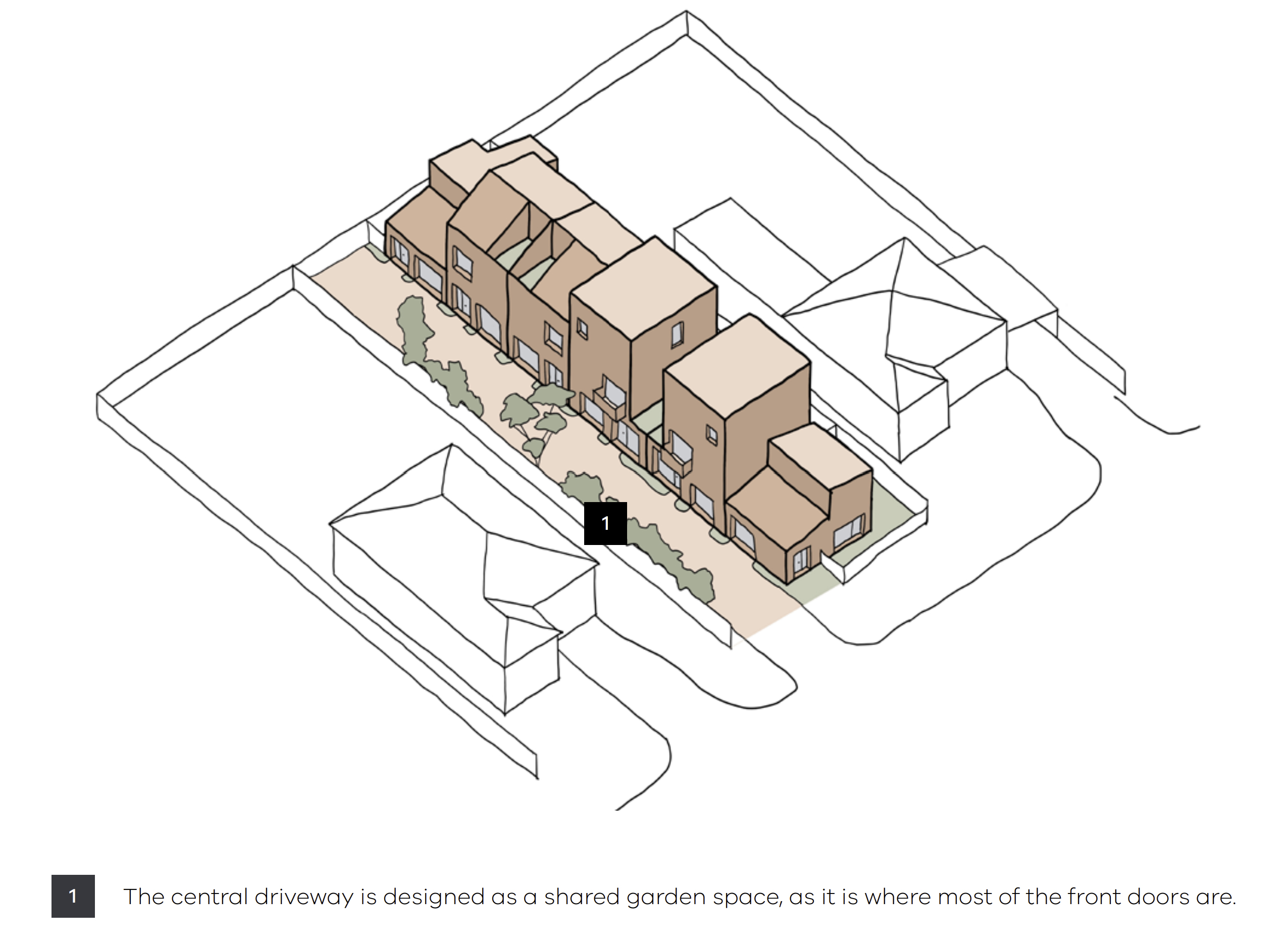
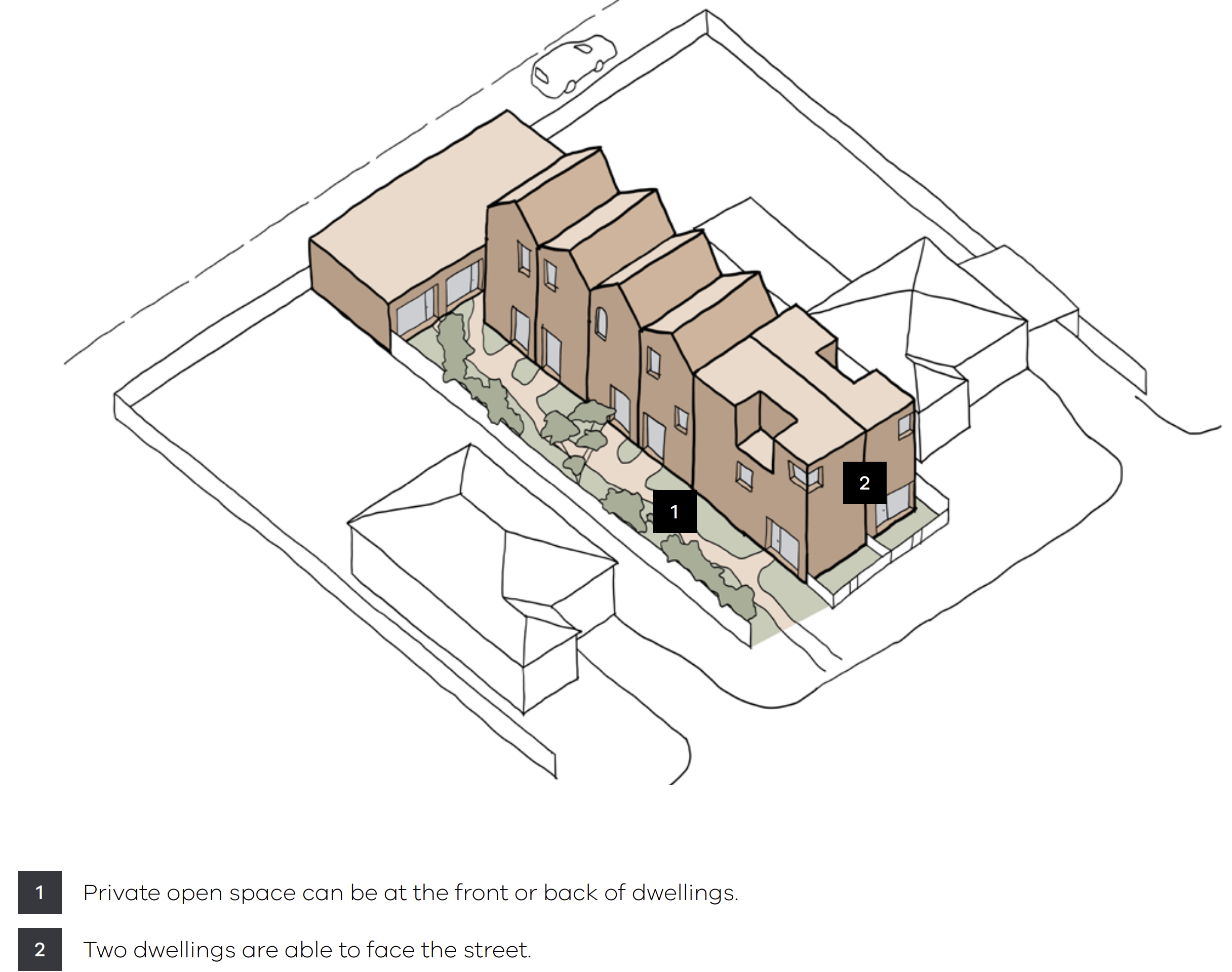
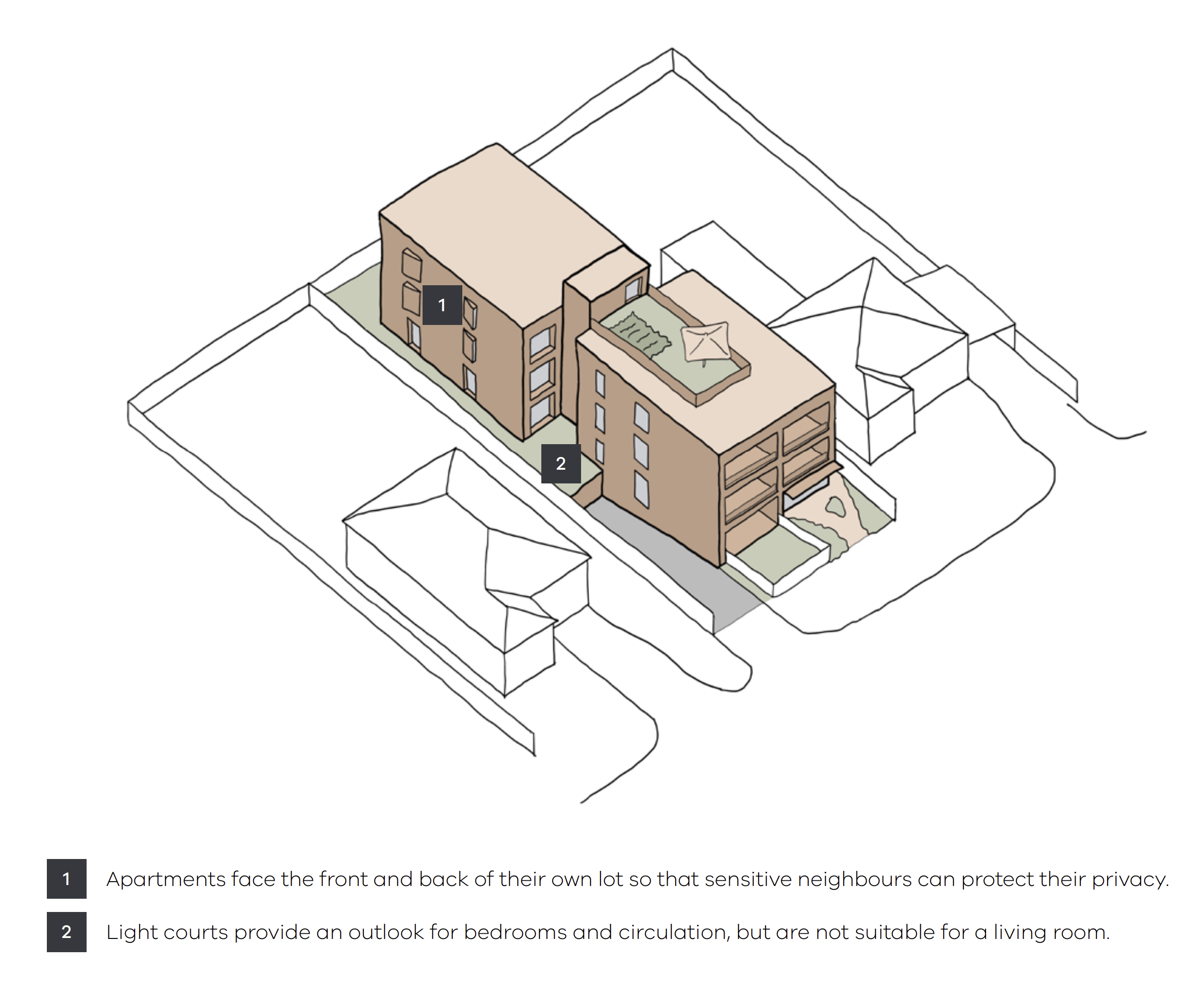
The examples below are drawn from the Department of Transport and Planning’s Designing Better Medium Density Housing in Victoria guide. They show townhouse developments that may be constructed on a single residential lot under the new planning controls.
Although these developments are classified as “low-rise”, buildings of up to three storeys are permitted. The images illustrate the scale and intensity of development that may occur in established residential streets, including the potential for increased overlooking, overshadowing and reduced garden space.
Less green space, fewer trees
The Code significantly weakens requirements for vegetation and open space:
- Tree canopy requirements reduced to 10% (or 20% on large lots)
- Private open space reduced to 25 square metres
This raises concerns about a return to heavily built-up sites with minimal greenery where vegetation is replaced by hard surfaces and building footprint.
There are also concerns that, beyond tree canopy targets, the Code contains limited requirements for meaningful landscaping or garden space. This means developments may include extensive hard surfaces, with trees planted in narrow strips, raised planters or constrained conditions that limit their ability to mature and provide long-term canopy benefits.
Critics argue that healthy urban greenery depends not only on planting trees, but also on retaining adequate soil, permeable surfaces, gardens and space for vegetation to thrive.
The cumulative effect across suburbs is expected to be a substantial loss of tree cover and gardenspace, with implications for urban heat, biodiversity, neighbourhood character and liveability. The target of 30% tree canopy is undermined. Street trees are not able to compensate for the loss on residential lots.
Standardised and lowered sustainability standards
Sustainability and energy efficiency requirements are now standardised across all councils.
While consistency may sound positive, in practice it means that stronger local standards previously applied in some areas have been overridden and reduced to a lower common denominator.
This limits the ability of councils to respond to local environmental challenges or to push for higher-performing buildings.
What this means for Melbourne
The Townhouse and Low-Rise Code is not just a technical update – it represents a shift towards faster, more standardised development at the expense of local input and design quality. Liveability is being sacrificed by bulkier buildings, less privacy, more overlooking, less greenery and darker streets.
The Government’s stated intent is streets of apartments close to transport and services with some 1-2 storeys homes in the outer (5-10 minute) walkable zones. With family sized apartments less viable for developers most developments are expected to be 1-2 bedrooms pushing families towards outer suburbs or further from transport and services.
The likely outcome is an increase in lower-scale developments delivered under weaker rules with cumulative impacts that will reshape suburban streets across Melbourne.
In the first 12 months the Code is in operation, Councils are reporting larger developments rather than an increase in the number of dwellings (yield) on a site. Although the Government has reported a 40% year on year increase in approvals this followed a substantial decline in the number of applications in the six months prior to the new code’s introduction.