
‘Better Decisions, Made Faster’ Bill
The Planning and Environment (Better Decisions, Made Faster) Act 2026 represents a major rewrite of Victoria’s planning system. Local councils were not consulted on the changes; however, they are responsible for much of the Act’s detailed implementation.
The stated aim is to deliver more housing by speeding up planning decisions and reducing delays. However, the changes also significantly alter who gets a say in planning decisions and how those decisions are made.
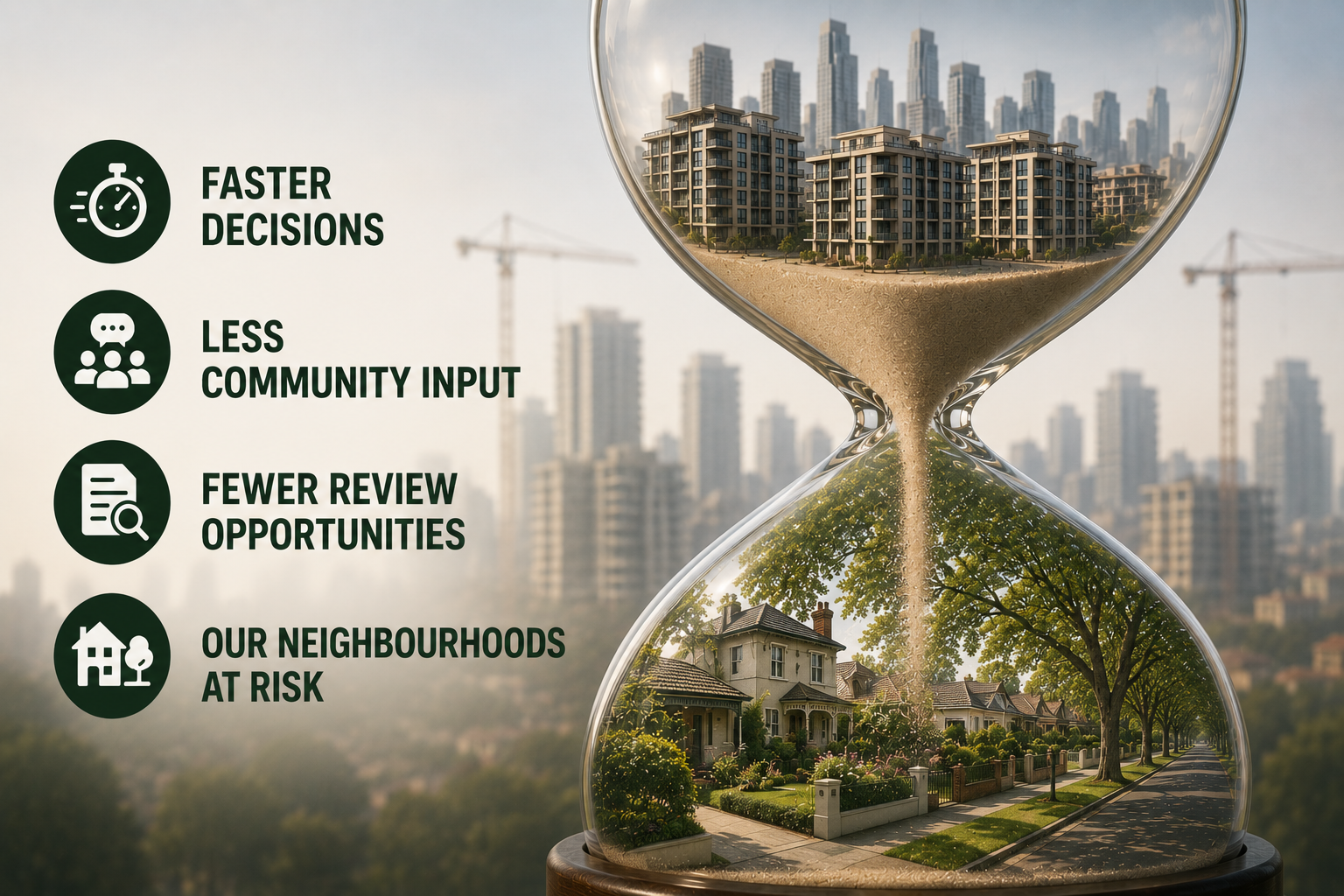
At a high level, the reforms shift the planning system towards faster decision-making, increased housing delivery and greater flexibility for development. Supporters argue this is necessary to address housing shortages and reduce planning delays.
Critics argue the changes reduce community participation, weaken appeal rights, make it easier to override longstanding neighbourhood protections such as restrictive covenants, and place greater emphasis on housing supply than on well considered planning outcomes that reflect the local context.
The practical impact of many reforms will depend on future regulations that are yet to be determined.
New objectives for the planning system
The Act changes the fundamental objectives of Victoria’s planning system. In addition to the traditional goals of orderly planning and environmental protection, it introduces new objectives relating to housing supply, housing diversity and affordability, social housing, climate change adaptation, and the rights and interests of Traditional Owners.
Inclusion of the affordable housing objective was critical to the Greens allowing passage of the Bill. However there is no mandated percentage of dwellings and no guarantee that any mandatory inclusion of affordable housing will be activated by the Government.
Planning permits will be fast-tracked
The Act introduces a new three-tier permit system:
Type 1 – Simple developments such as houses, duplexes and small subdivisions.
- Target approval time: 10 days.
- No public notice.
- No right for neighbours to object or appeal.
Type 2 – Medium-density developments such as many townhouse and low-rise apartment projects.
- Target approval time: 30 days.
- Limited notice requirements.
- No third-party appeal rights.
Type 3 – Larger or more complex developments.
- Target approval time: 60 days.
- Some notice and appeal rights remain, but only for certain people who receive direct notice.
In simple terms, many developments that currently allow residents to object and appeal may in future proceed with far less community involvement. The emphasis of the new system is on faster approvals and fewer opportunities for delay.
Restrictive covenants will be easier to override
A restrictive covenant is a legal restriction placed on land, often designed to protect the character of an area. Examples include limits on subdivision, building height or the number of dwellings on a property.
The reforms give councils and VCAT greater discretion to remove or vary restrictive covenants. They also allow planning permits to be granted even where a proposal would breach an existing covenant. Previously, the impact on beneficiaries of the covenant and potential financial loss were more important considerations. Under the new system, greater weight can be given to broader planning policies and housing objectives.
For many established suburbs, this represents a significant shift because restrictive covenants have historically provided an additional layer of protection against overdevelopment.
What this means for Victoria
The “Better Decisions, Made Faster” Bill is not just a procedural update – it fundamentally changes how planning power is exercised in Victoria.
By concentrating authority in the hands of the Minister and reducing opportunities for community input and review, it replaces a locally informed planning system with a more centralised and less transparent model.
The result is a planning framework that prioritises speed and state-level decision-making, while significantly reducing the ability of communities to influence the future of their neighbourhoods and environment.