
Development Facilitation Program (Affordable Housing)
The Development Facilitation Program for affordable housing is a planning pathway for large-scale housing developments, typically valued at $50 million or more.
Under this program, developers apply directly to the Minister for Planning for a planning permit rather than to a local council. Projects are assessed centrally, with decisions made by the Minister based on factors such as scale, speed of delivery, and economic impact. Councils may make a submission during the normal 14 day public notice period, a period of time that does not allow for a well-considered and in-depth response.
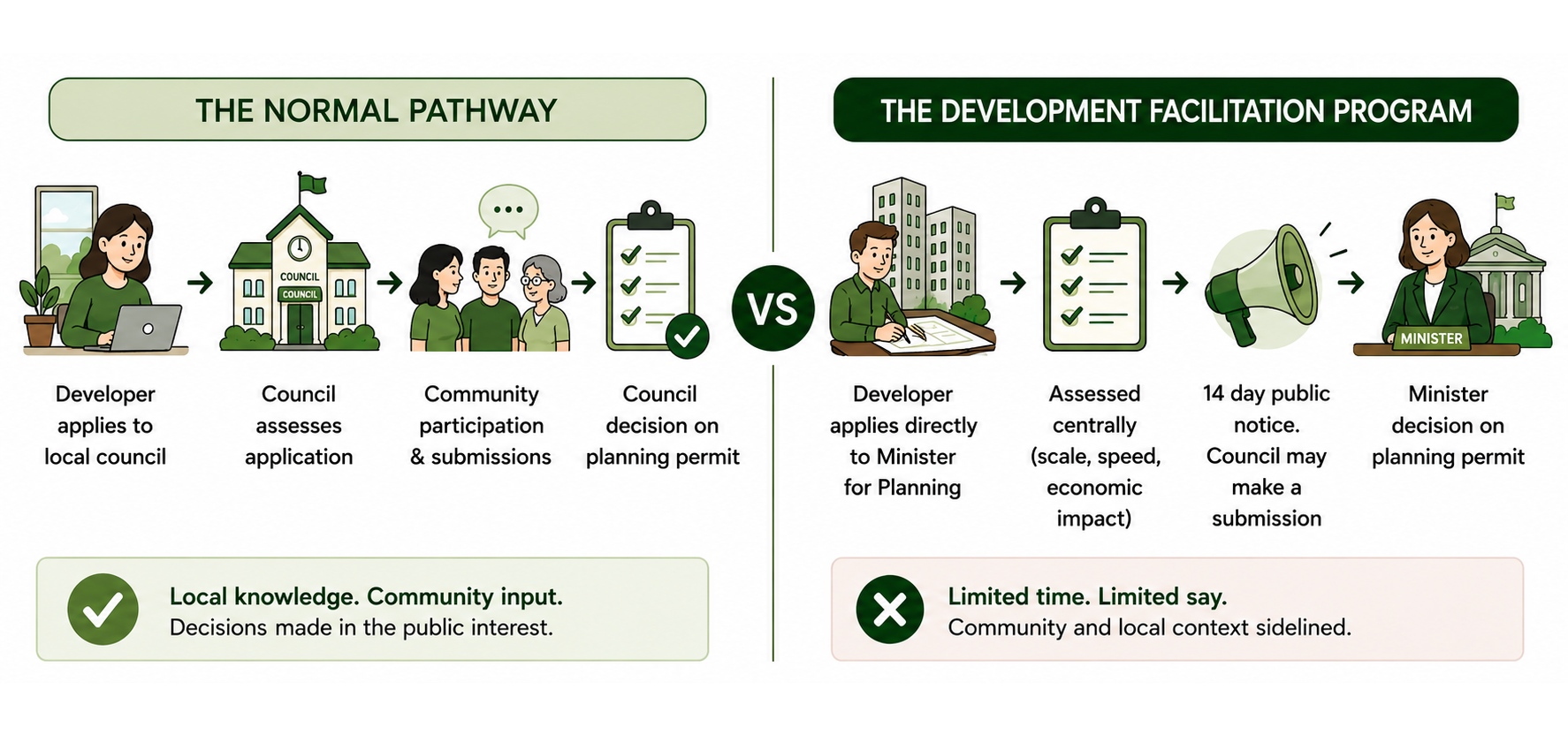
A lengthy pre-application process, including viability testing, undermines the ability of the pathway to deliver permits faster. Despite the intention that projects would be “shovel ready” councils are reporting that the construction lag is lengthening.
There is no obligation on the developer to proceed with the development. The uplift in value of the land that occurs when a permit is granted can be “banked” either through holding the property or selling.
Ministerial approvals have already been granted for developments in Boroondara that result in poor planning outcomes. For example, one approved development would leave open space with only one hour of sunlight during winter.
Affordability commitments under pressure
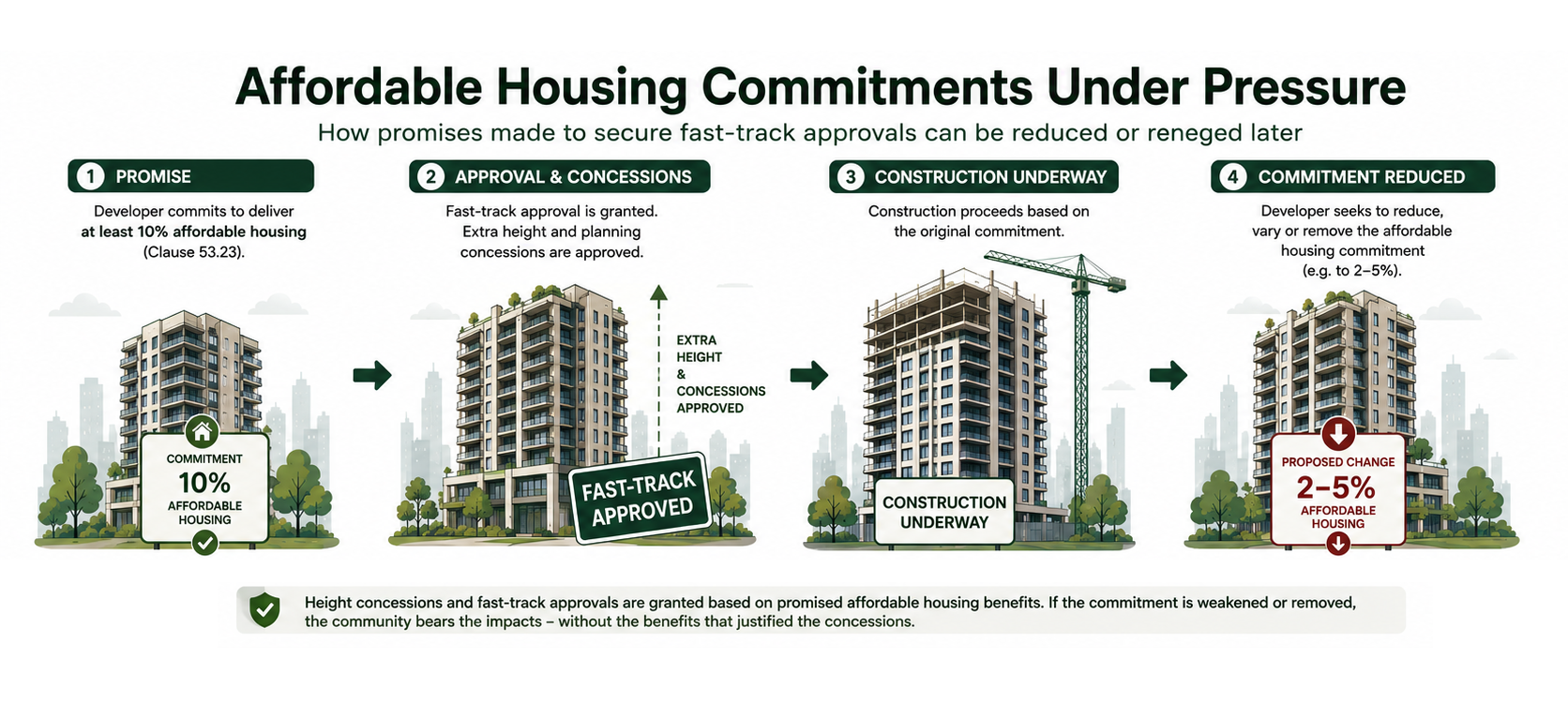
Developments approved through the program may include an expectation of a 10% affordable housing contribution. Rental of these dwellings is generally managed by a community housing provider. Rent is priced at a discount to market for the location and should not exceed 30% of the household’s gross income. Income bands limit eligibility.
However, concerns have been raised that:
- These contributions are small relative to the uplift in development value
- Commitments can be weakened, varied, or effectively avoided after approval, as has already occurred in the Assemble developments in Brunswick and Coburg.
As a result, the long-term delivery of “affordable housing” benefits is uncertain and may not match the scale of the developments being fast-tracked.
Speed over scrutiny
The core objective of the program is to accelerate housing delivery and reduce the risk of project delays associated with objectors seeking review at VCAT. However, a dedicated fast-track process at VCAT had already substantially reduced that risk to just a few months.
While permits may be issued in a slightly shorter time frame, it does so by:
- Reducing detailed local assessment
- Limiting transparency in decision-making
- Allowing variations to planning rules: eg setbacks
- Prioritising economic impact and volume over neighbourhood considerations
What communities receive
In practice, communities often experience:
- Lasting changes to neighbourhood character and infrastructure demand
- Limited ability to shape or challenge outcomes
- Uncertainty about whether promised public benefits are fully delivered
Meanwhile, affordability outcomes are not guaranteed.
Financial contributions in lieu of delivering affordable dwellings are to a Social Housing Growth Fund, itself a non-transparent vehicle, and there is no requirement that the funds will be used for affordable housing in the municipality where the approval was given.
What this means for Melbourne
The Development Facilitation Program reflects a broader shift towards centralised, state-controlled planning approvals for major housing projects. Together with other fast tracks and programs, a separate planning scheme is emerging.
By prioritising speed and economic output, the role of local planning schemes is reduced and the link between development approvals and enforceable community benefits is weakened.
The result is a system where large-scale developments can proceed more quickly, while the long-term impacts are absorbed locally, often without equivalent, secured returns for the communities affected or certainty that anticipated affordable housing outcomes will ultimately be delivered.